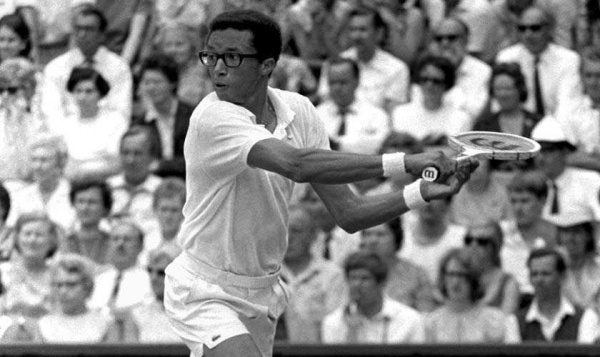

Every so often, someone comes along who possesses all the great qualities we need of our American icons, and Arthur Ashe was one of those rare few. Ashe had talent, intelligence, grace and a humanitarian streak which endeared him to all. From the humblest of beginnings in Virginia, Ashe rose to become a three-time Grand Slam Champion, forever cementing him as one of the greatest of America’s tennis players.
Arthur Robert Ashe Jr was born in Richmond, Virginia on July 10th, 1943, to Mattie and Arthur Senior. Arthur Sr. was a groundskeeper by profession, and when his son was still only four years old, Arthur was employed at Brook Field, which included a number of outdoor tennis courts. It was here that Arthur first learned tennis. The young Ashe had a knack for the game, and was soon noticed by Ronald Charity, one of the nation’s top black players, and a part-time instructor. By the time he was just seven, Ronald introduced Ashe to Dr. Walton Johnson, a major amateur tennis coach in Lynchburg, Virginia. Johnson was impressed by the young Ashe, and agreed to take him as a student. His time with Johnson hammered a strong sense of sportsmanship and gentlemanly conduct into Ashe.

The time with Johnson paid off, and Ashe regularly competed in major amateur tournaments across the nation, earning acclaim as one of America’s top young players. At the same time however, Ashe was not allowed to play against white opponents, or use white courts in his home state of Virginia. Highly regarded for his skills, and a straight A student as well, Ashe met with a scout from St. Louis, and was given an offer to play at Sumner High School. Ashe accepted, and took his final year in St. Louis playing in integrated tournaments and playing much stronger opponents. Graduating first in his class, Ashe was given a full academic and athletic scholarship to the University of California, Los Angeles.

At UCLA, Ashe was a standout player, being selected as an All-American for three years, and winning the National Collegiate Athletic Association singles and doubles titles. Most remarkably, he was named to the US Davis Cup team for the first time while still a student, competing for America on the world stage. For these exploits, Ashe was featured in Sports Illustrated for the second time, as a major young student athlete. Ashe graduated with a degree in Business Administration and as a member of Kappa Alpha Psi in 1966, the first member of his father’s family to graduate from college. After UCLA, Ashe enlisted in the US Army, serving as First Lieutenant, and being given time to compete in amateur tournaments and in the Davis Cup. In 1968, Ashe won the US Amateur Champions, and also Ashe played in the inaugural united US Open tournament. Ashe won the Open, the first of his Grand Slam wins, but his status as an amateur player at a professional tournament meant his opponent retained the prize money.

Ashe returned to his post at West Point to a standing ovation from his fellow soldiers, and made the decision to leave the army and become a professional tennis player. As a professional, Ashe was ranked as America’s top men’s singles player, and a regular member of the American Davis Cup squad. In 1969, Ashe was ranked number one in America, and decided to compete for the South African Open. The apartheid policy meant that his visa request was denied by the South African government, but Ashe would continue to attempt to register to play at Johannesburg year after year, and continue to be denied. Until the fall of apartheid, Ashe would continue to call for South Africa’s expulsion from the International Lawn Tennis Association.

In 1970, in Sydney, Ashe won the Australian Open, the second of his Grand Slam wins. Tennis was becoming popular again, and Ashe was one of its foremost celebrities. He used his celebrity status to advance his interest in social causes, creating organizations such as the National Junior Tennis League, which introduced tennis to underprivileged youth, and the Association of Tennis Professionals, which would give players a voice in how the sport was run. In 1973, under increasing pressure, South Africa granted Ashe his visa, and he won the doubles title at Johannesburg that year. In 1974, Ashe was elected to serve as the ATP President, an honor given to him by his fellow players who recognized his outstanding play, his sportsmanship, and his dedication to social causes. The next year, Ashe would play the match of his life, against Jimmy Connors at the 1975 Wimbledon Men’s Singles final.

Ashe and Connors had met previously, and didn’t like each other. Connors was excluded from the 1974 French Open because of his involvement in World Team Tennis. The dispute led to legal action and heightened tensions within the sport. Never before had two more different players competed for a Slam. In 1975, Ashe was already slowing down, as he entered his thirties. Connors was a young, loud power player, who shouted and cursed on court – a sharp contrast to the quiet and composed Ashe. Connors was heavily favored by the oddsmakers, with a speedy, energetic game that was thought to be perfect for the grass courts of Wimbledon, and with the advantage of youth. Ashe prepared carefully for the final, varying the pace and using sliced backhands, well-placed serves, lobs and effective net play to disrupt Connors’s rhythm. He won in four sets, 6–1, 6–1, 5–7, 6–4.

Wimbledon was Ashe’s last Grand Slam singles title; he won it shortly before his 32nd birthday. In 1979, Ashe underwent quadruple-bypass surgery and retired soon afterwards. He stayed active in his retirement, working as a sports journalist and commentator for ABC Sports. He continued to protest against Apartheid, and was arrested outside the South African embassy in 1985. The same year, he was elected to the International Tennis Hall of Fame. In 1986, Ashe began compiling a book detailing Black American athletes. ‘A Hard Road To Glory’, one of the foremost texts in the field, was completed just two years later. Ashe’s life would change again however, in 1988, after he began to feel numbness in one of his hands. He was diagnosed with toxoplasmosis and HIV, received from a blood transfusion in 1983. Ashe kept the condition secret, and continued to work against apartheid, visiting South Africa in 1991 as apartheid legislation was being repealed and the country was moving toward integration.

In 1992, it was made known to Arthur that the media had become aware of his condition. Ashe held his own press conference announcing his condition, and using his celebrity to raise the profile of the disease, founding the Arthur Ashe Foundation for the Defeat of AIDS, and speaking to the United Nations. Ashe died of AIDS-related pneumonia on February 6th, 1993, leaving behind a wife and young daughter. Ashe was celebrated as one of the foremost athletes and humanitarians of his era. From apartheid, to inner city youth, to Haitian refugees, to his own illness, Ashe tirelessly worked to advance the cause of those less fortunate. Celebrating one of its favorite sons, the city of Richmond erected a statue of the late Ashe in 1996, on Monument Avenue, a formerly segregated memorial park. The US Open would commemorate Ashe in 1997, naming its new center stadium Arthur Ashe Stadium, ensuring that the first champion of the Open era of tennis would not be forgotten. Today, Arthur Ashe Kids Day brings children, athletes and celebrities together on the day before the US Open to encourage community involvement and education through tennis, in memory of one of America’s greatest athletes.
More than a trophy list
Ashe co-founded the National Junior Tennis League in 1969 with Charlie Pasarell and Sheridan Snyder, using tennis to broaden opportunity and develop life skills. His three-volume A Hard Road to Glory, published in 1988, also placed the history of Black athletes at the centre of his work.

Leave a Reply